Your decisions
deserve your own
model.
System One Studio (formerly Laya Studio) fine-tunes open System One models, starting with Laya, on your own labeled data and your own machine: MLX on a Mac, PyTorch on NVIDIA, AMD or Intel GPUs, or just the CPU. No cloud, no per-call bill, and every run proves whether it actually got better. When it has, publish it to System One Models in one click.
pip install systemonemodels && systemone run studioreads your hardware, installs the right stack, opens the studio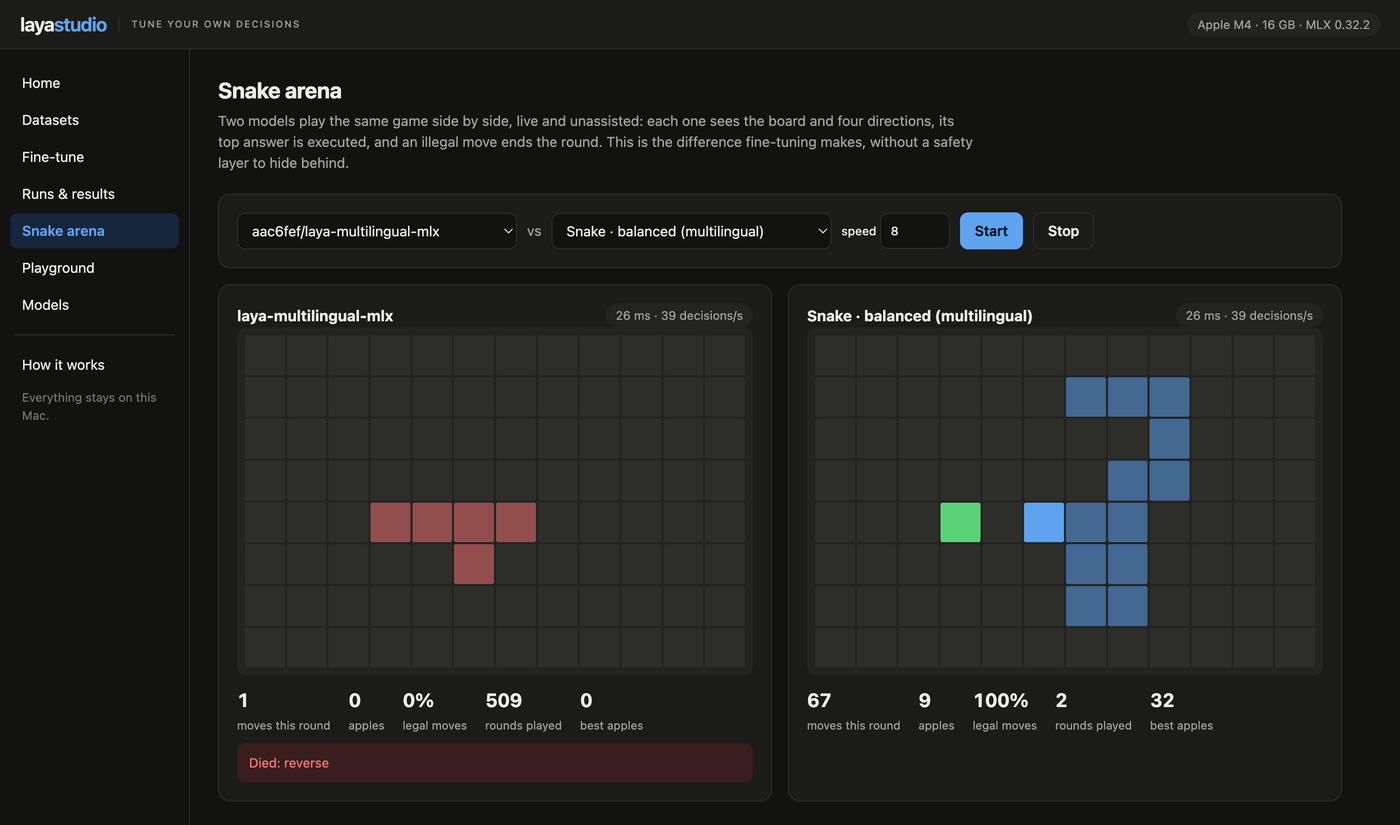
What it does
You bring labeled decisions, the studio does the rest: check the data, adapt the model, measure it honestly, hand you a checkpoint you can ship. Nothing leaves the machine at any step.
Read the docs ↗Measured, not promised
| Task | Answers | Before | After | Training time |
|---|
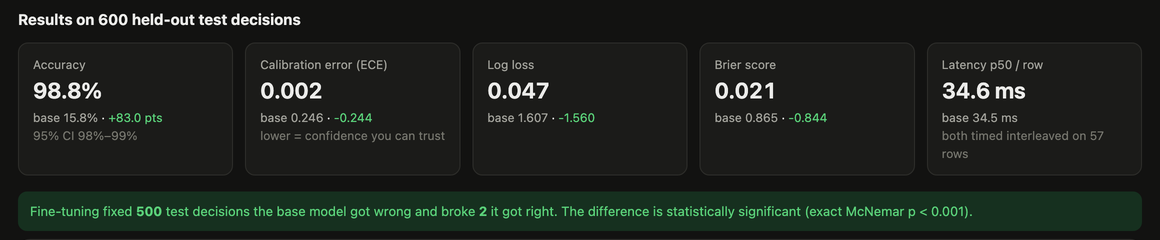
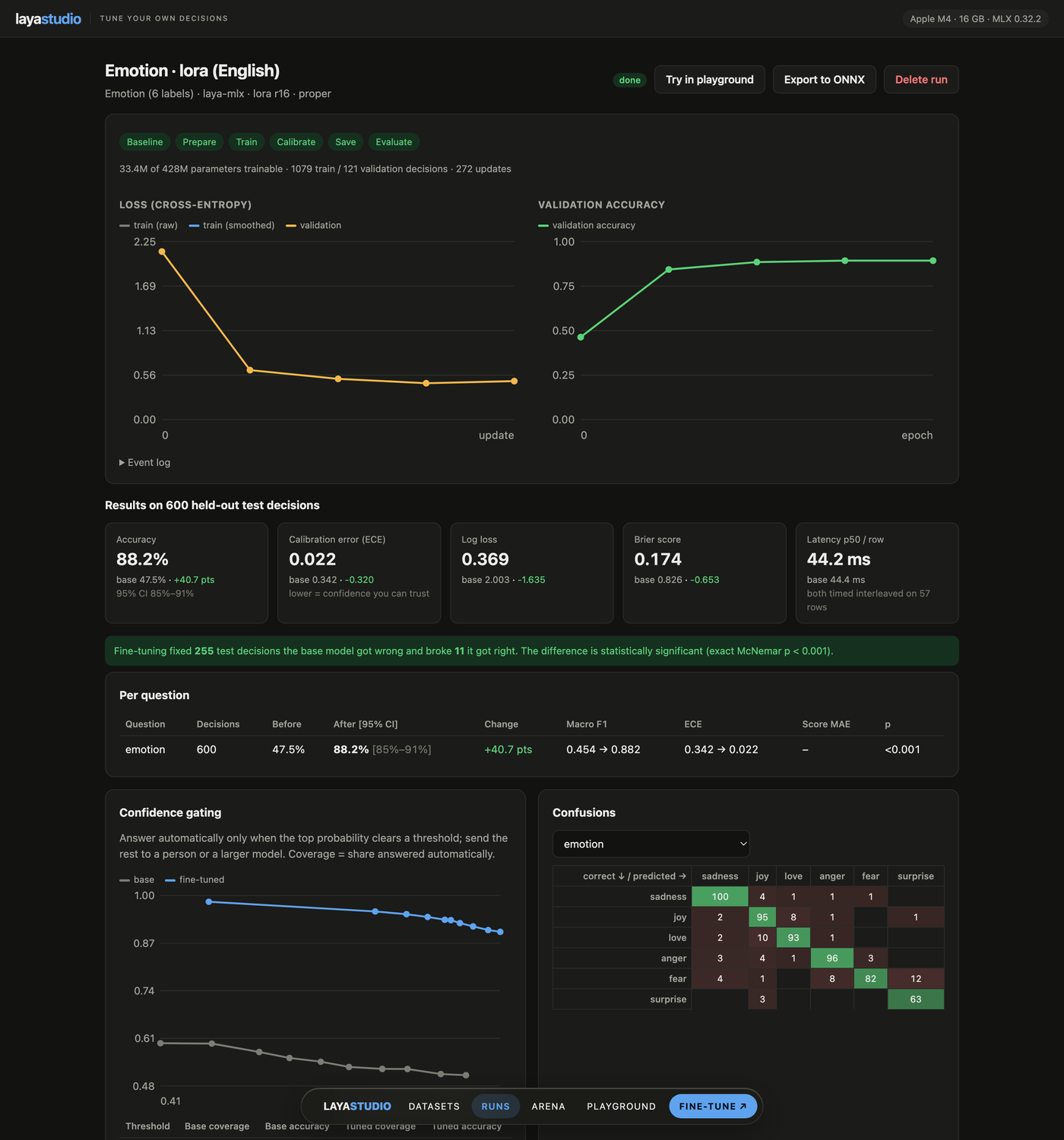
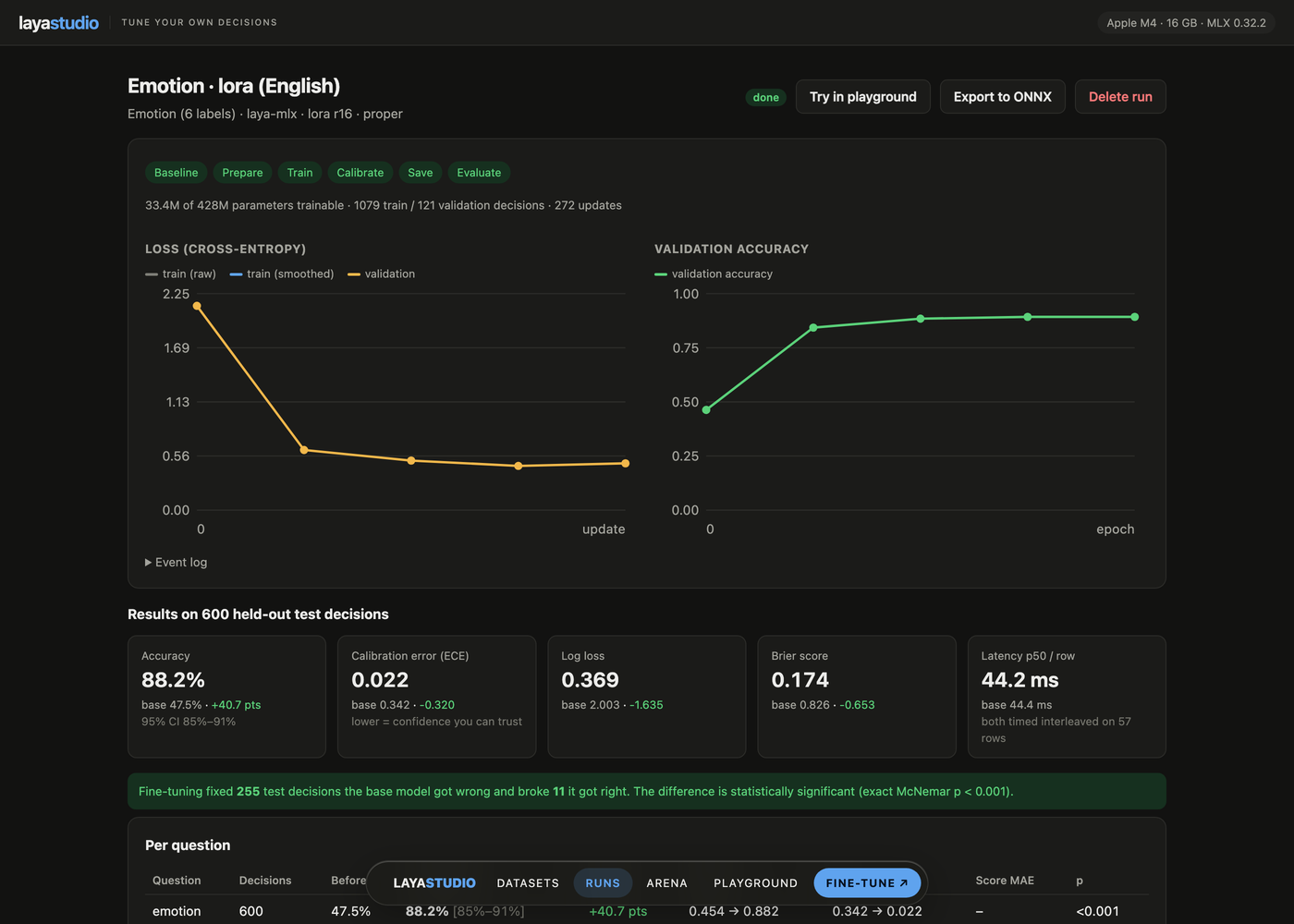
Test rows are never trained on, accuracy comes with a 95% interval and an exact McNemar test, and fine-tuning does not change inference speed: the adapters are merged into the weights.
Does it really learn?
No hints and no safety layer: the model sees the board and four directions, its top answer is executed, and an illegal move ends the round.
Both public checkpoints are guessing at this task: 33.0% and 19.0% move accuracy, below the 25% a coin flip would give. Eighteen minutes of local fine-tuning takes it to 98.8%.
| Moves | Apples | Legal | |
|---|---|---|---|
| Base 322M | 1.0 | 0.0 | 0% |
| Fine-tuned | 169 | 19.8 | 99.3% |
| Planner (ceiling) | 418 | 34.4 | 100% |
Then take it anywhere
Laya checkpoint
36 msFP16 safetensors with the original parameter names. Loads in laya-mlx on Apple silicon and in upstream PyTorch on Linux and NVIDIA — verified 40/40 identical answers.Core ML · int8
8.8 ms308 MB for the Apple Neural Engine: four times faster than the runtime that trained it, a quarter of the size, and not one of 100 held-out decisions changed.ONNX
83 msOpset 18, dynamic batch, tokens and options. Runs wherever onnxruntime runs — Linux and Windows CPU, CUDA, DirectML. Same 98.0% on the same held-out rows.Every export is scored against the model it came from, on the same untouched rows — which is how you find out that int8 costs nothing here and int4 costs 28 points of accuracy.
On the machine you have
Apple silicon
MLXThe native runtime on M-series Macs, and the default there: 82.7% on Emotion after 4 min 45 s on a 16 GB M4.NVIDIA
CUDAPyTorch with the CUDA build your driver supports, chosen for you from the card and driver it finds.AMD
ROCmROCm on Linux, and AMD's own PyTorch wheels on Windows for Radeon and Ryzen AI.Intel · any CPU
XPU · CPUIntel Arc through XPU, or the CPU of any machine when there is no GPU to use.Same recipe everywhere: on one Mac, MLX and PyTorch reached 82.7% and 83.3% and gave the same answer on all 200 test questions, so a model trained on a Mac runs unchanged on a Linux GPU. LoRA, DoRA, rsLoRA and LoRA+ work on both. Measured so far on Apple silicon; read the MLX vs PyTorch measurement ↗
Part of System One Models
System One Studio is the fine-tuning half of System One Models (systemonemodels.tech), the registry for System One models: decision models that return typed answers with calibrated confidence instead of text.
Browse every System One model in one place (Jev, Laya, Kev, GLiNER2.5-Decide, Nimble and more), compare them side by side, pull any open one with one command, and publish your fine-tune back from the studio in one click, signed in through the same systemone CLI.
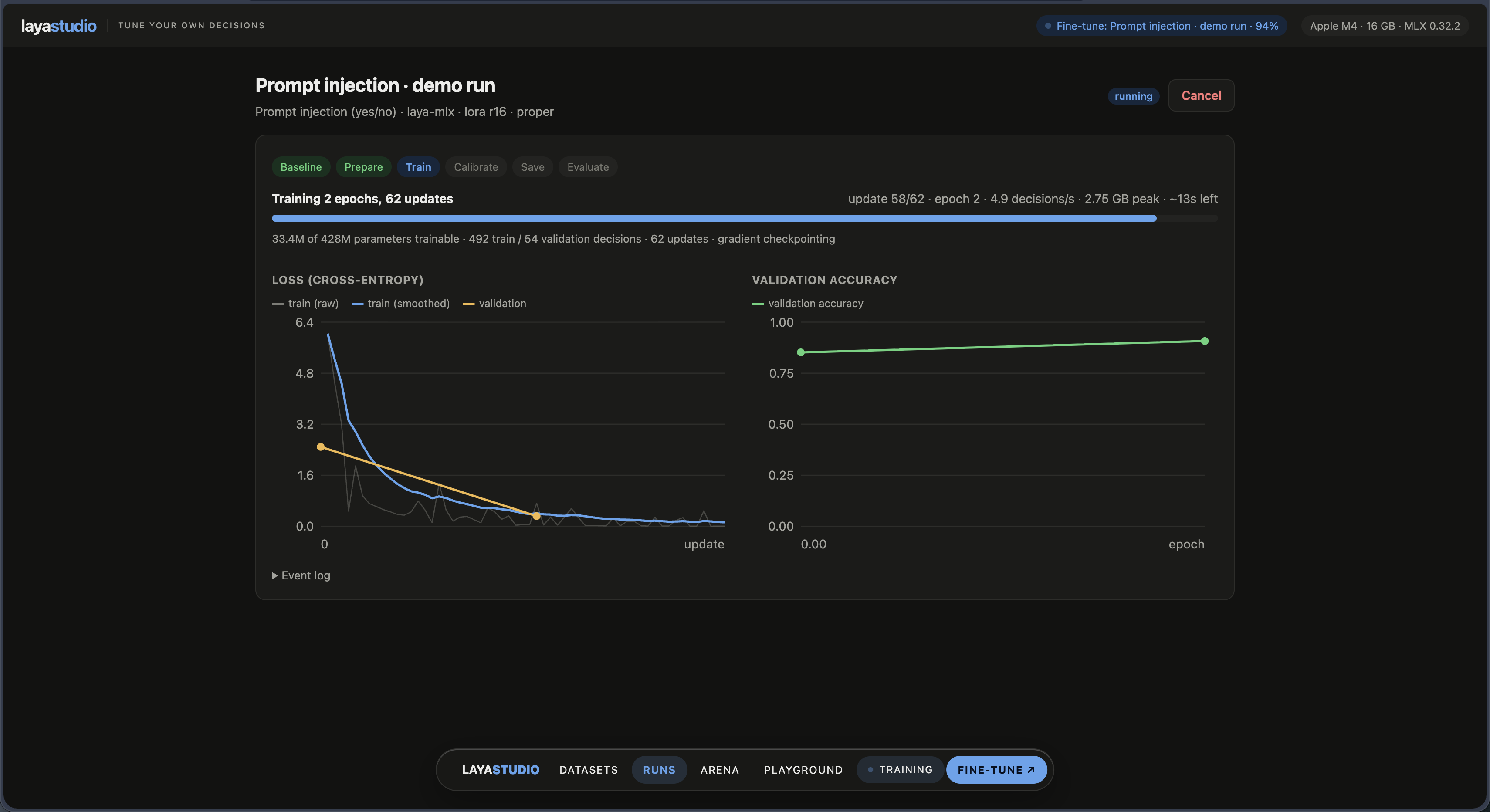
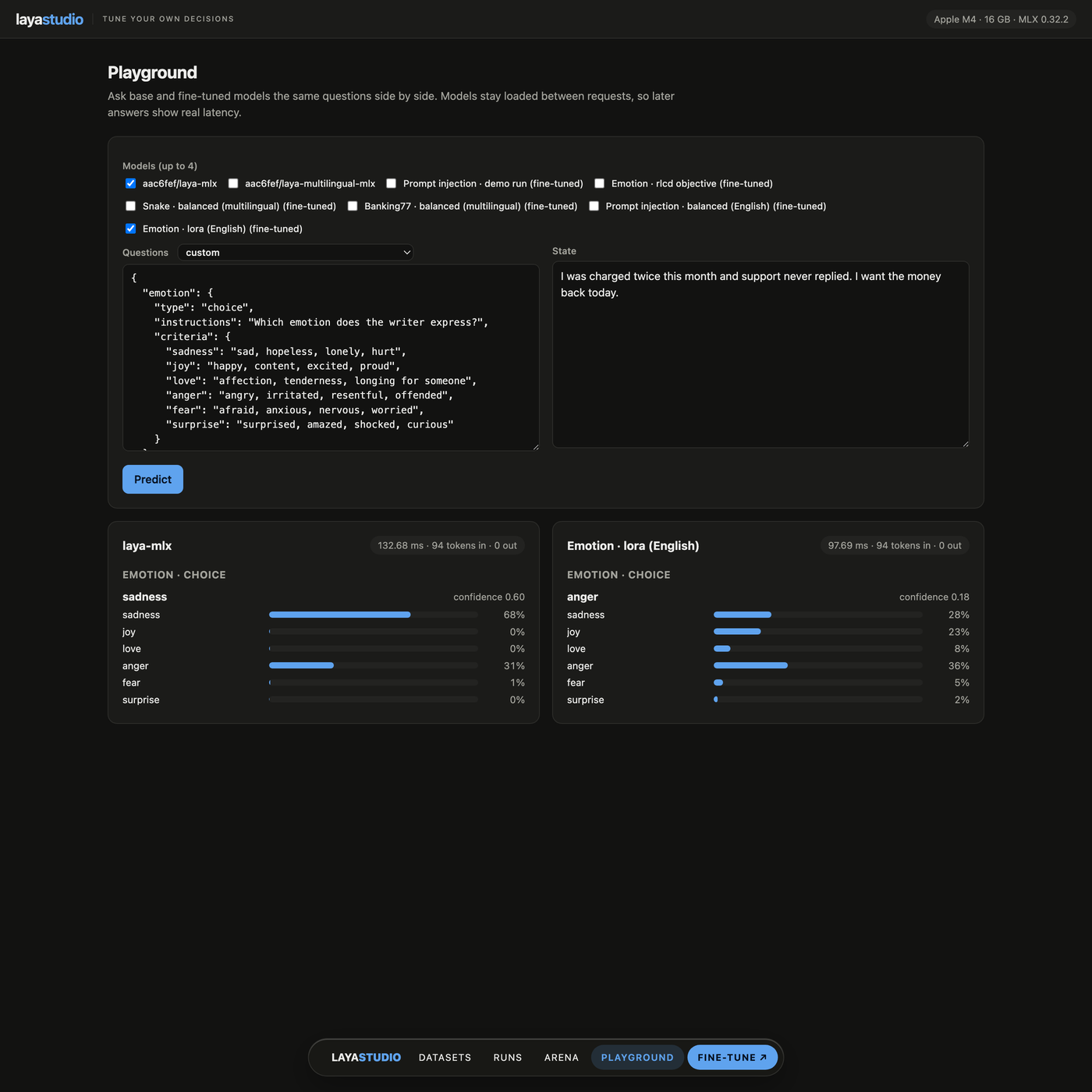
Inside the studio
Start in one command
pip install systemonemodels && systemone run studioFrom source instead: git clone https://github.com/biplovgautam/LayaStudio && cd LayaStudio && uv run layastudio